
Why Is It Called “Polycystic” If I Don’t Have Cysts?
This is where the old name caused trouble.
The “cysts” seen in PCOS are actually small antral follicles involved in egg development, not pathological ovarian cysts. When ovulation is disrupted, these follicles may remain at an early stage, creating the characteristic appearance on ultrasound.
But you can have PCOS without this ultrasound appearance, and seeing multiple follicles does not automatically mean you have PCOS.
An ultrasound is one piece of the diagnostic puzzle, not the diagnosis itself.
And that brings us to an important question.
How Is PCOS Diagnosed?
There is no single blood test that says, “Congratulations, you have PCOS.”
PCOS is a clinical diagnosis based on a combination of findings, while excluding other conditions that can look similar.
For most adults, the diagnosis requires two of three features:
1. Hyperandrogenism
This means evidence of excess androgen activity. It can be biochemical, with elevated androgen levels on blood testing, or clinical, with signs such as:
- Hirsutism — coarse, dark hair growth on the face, chin, chest, abdomen, or other androgen-sensitive areas.
- Significant acne — persistent or severe acne, particularly when it develops in adulthood or is concentrated along the jawline and lower face.
- Androgen-related scalp hair loss — gradual thinning or widening of the part, typically concentrated over the crown and top of the scalp.
When testing is appropriate, total and free testosterone are particularly useful.
2. Ovulatory Dysfunction
This generally shows up as irregular menstrual cycles because ovulation isn’t happening consistently.
That doesn’t necessarily mean your period disappears. Some women simply have consistently long cycles; others may go months without bleeding.
The question is whether ovulation is happening regularly.
3. Polycystic Ovarian Morphology
This means an increased number of small follicles seen on ovarian ultrasound. In adults, AMH (anti-Müllerian hormone) — a hormone produced by developing ovarian follicles — can also be used as an alternative to ultrasound when appropriate. You don’t need both.
If you already have irregular cycles plus hyperandrogenism, you generally don’t need an ultrasound or AMH to make the diagnosis.
We also need to exclude other conditions that can cause similar symptoms, including thyroid disease, elevated prolactin, nonclassic congenital adrenal hyperplasia and pregnancy.
PCOS is a diagnosis of pattern recognition and exclusion — not a diagnosis made from one abnormal hormone level.
PCOS Treatment Depends on Your Goal
You may be thinking, “All of that is great, but what do I actually do about it?” Fair question.
There is no universal PCOS medication that every woman should take simply because she has the diagnosis. Treatment depends on what you want to accomplish.
At Elam Health & Wellness, I look at the whole picture—not just your ovaries or your lab results. We take the time to understand what is actually bothering you, what you want to change, and what your overall health looks like before deciding what treatment makes sense.
Are you trying to:
- Lose weight?
- Get your periods under control?
- Improve your metabolic health?
- Treat acne, unwanted hair, or hair loss?
- Protect your uterine lining?
- Become pregnant?
Those are different problems, and they may require different treatments.
My goal isn’t to treat the diagnosis on paper. It’s to treat the woman sitting in front of me.
PCOS Treatment for Weight Management and Metabolic Health
For many women, the first goal is: “I want to lose weight, improve my metabolic health, and feel better.”
That is a perfectly reasonable medical goal.
PCOS is associated with increased risk of insulin resistance, prediabetes, type 2 diabetes and other cardiometabolic risk factors.
But one distinction is important: Weight is not the definition of PCOS.
You can have PCOS at any body size, and you do not need to lose weight to “prove” your diagnosis.
If weight loss is your goal, we can absolutely treat it as a medical objective. Nutrition, physical activity, resistance training, sleep and behavioral strategies all play a role, and medication may be appropriate for some patients.
The right approach depends on your health history, metabolic risk, medications, reproductive plans and what you are realistically able to do.
If weight management is one of your goals, I go deeper into the science and evidence-based treatment options in my article on the interplay between hormones and weight. And no, managing PCOS does not require surviving on grilled chicken and sadness. The goal is a sustainable approach that improves your health, not the most miserable diet you can tolerate for three weeks.
PCOS Treatment for Regular Periods and Endometrial Protection
If your biggest problem is that your period has become unpredictable, we may have a different priority.
Irregular ovulation means the uterine lining can be exposed to estrogen without regular progesterone from ovulation. Over time, this can increase the risk of endometrial hyperplasia and, eventually, endometrial cancer.
That does not mean every woman with PCOS is destined to develop uterine cancer. It does mean chronically absent periods should not simply be ignored.
If pregnancy is not your current goal, treatment may include hormonal contraception or intermittent progestin therapy, depending on your circumstances. Combined hormonal contraceptives can also help with androgen-related symptoms such as acne and hirsutism.
One important clarification: Birth control pills do not cure PCOS.
They can treat several of its manifestations while providing contraception and endometrial protection. That is different from treating the underlying condition.
PCOS Treatment for Acne, Hirsutism and Hair Loss
Sometimes the problem isn’t your period. It’s your chin, your jawline, or the fact that your hairbrush seems to be collecting more hair than it should. And if hair loss is part of the picture, there are many possible causes of hair loss beyond PCOS, so it is worth figuring out which one you’re actually dealing with.
Androgen excess can contribute to hirsutism, acne and androgenic scalp hair loss. Treatment depends on the specific symptom and whether pregnancy is currently possible or desired. Combined hormonal contraception can help reduce androgen-related symptoms in appropriate patients, while anti-androgens such as spironolactone may be considered when appropriate, with contraception when needed because of potential fetal effects.
Sometimes we treat the symptom directly too. Laser hair removal, electrolysis, acne medications and dermatologic treatments can all have a role.
You do not need to spend six months drinking teas and balancing chakras in hopes of balancing your hormones. Together, we can treat the problem you actually have.
PCOS Treatment for Fertility
This is where the treatment strategy changes significantly.
PCOS is one of the most common causes of anovulatory infertility, but PCOS does not mean you cannot become pregnant. It means you may not ovulate consistently.
If pregnancy is your goal, the question becomes: Are you ovulating, and if not, how can we safely restore ovulation?
For women with PCOS and anovulatory infertility, with no other infertility factors, letrozole is the recommended first-line medication for ovulation induction.
That is very different from using birth control to regulate bleeding when pregnancy is not desired.
This is exactly why treatment starts with your goal. The treatment for “I don’t want to get pregnant” is not the treatment for “I am trying to get pregnant.”
And one misconception worth retiring: PCOS does not mean you cannot get pregnant unexpectedly. You may ovulate irregularly rather than not at all, so if pregnancy is not your goal, contraception still matters.
PCOS Treatment for Long-Term Health
Even if pregnancy is nowhere on your radar, PCOS still deserves attention.
This is one of the reasons I think of PCOS as a long-term health condition, not simply a fertility diagnosis.
Depending on your individual risk factors, we may monitor your:
- Blood pressure and cholesterol
- Glucose metabolism and diabetes risk
- Weight trajectory
- Sleep
- Mental health
- Menstrual patterns and endometrial health
PCOS is associated with increased metabolic risk, cardiovascular risk factors, sleep apnea and psychological symptoms, including anxiety and depression.
That does not mean you are destined to develop diabetes, heart disease or sleep apnea. It means your diagnosis tells us what deserves attention. And that is useful.
What PCOS Does Not Mean
Let’s clear up a few things.
PCOS does not mean you have ovarian cysts.
PCOS does not mean you are infertile.
PCOS does not mean you are overweight.
PCOS does not mean you need birth control.
PCOS does not mean you need metformin.
PCOS does not mean you need to eliminate carbohydrates.
PCOS does not mean you need to lose weight before your symptoms can be treated.
And perhaps most importantly, PCOS does not mean your entire medical care plan should revolve around your reproductive system.
Your metabolic and cardiovascular health matter too.
The Bottom Line

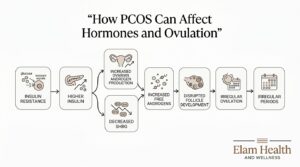
PCOS, now officially called Polyendocrine Metabolic Ovarian Syndrome (PMOS), is a complex endocrine condition involving reproductive hormones, androgen activity, metabolism and ovarian function.
The name changed because the old name did not tell the whole story. The condition itself has not suddenly changed. What matters now is figuring out what it means for you.
Maybe you are struggling to lose weight, dealing with irregular periods, acne, unwanted hair or hair loss, trying to get pregnant, or simply wondering whether your symptoms could be PCOS.
You do not have to know exactly what you need before making an appointment.
At my practice, we can review your symptoms, history and labs, determine whether PCOS fits the picture, and talk through your options based on your goals and your overall health.
There is no one-size-fits-all PCOS treatment because there is no one-size-fits-all woman with PCOS.
Further Reading
For a patient-friendly overview of PCOS symptoms, diagnosis, treatment and fertility, I recommend the American College of Obstetricians and Gynecologists’ patient resource:
[American College of Obstetricians and Gynecologists (ACOG): Polycystic Ovary Syndrome (PCOS)] ACOG: Polycystic Ovary Syndrome (PCOS)
Evidence Base
This article is informed primarily by the 2023 International Evidence-Based Guideline for the Assessment and Management of Polycystic Ovary Syndrome, developed through an international collaboration involving systematic reviews, evidence-based recommendations and consensus recommendations.
The 2026 PMOS name change was developed through an international consensus process involving 56 patient and professional organizations, including the Endocrine Society and American Society for Reproductive Medicine.